
The SME Paradox: Why You’re Likely Ignoring the Solution to Your Biggest Business Problems
If you run a Small or Medium-sized Enterprise (SME), you already know the reality: you are likely overworked, under-resourced, and constantly fighting fires. You wear every hat in the building, from CEO to head of HR to sometimes even tech support.
You also hear the relentless buzz about Artificial Intelligence (AI). You read headlines about how AI is transforming industries, automating everything, and generating billions in value.
Here lies the great paradox of modern business: The companies that need AI the most—SMEs—are often the slowest to adopt it.
While giant corporations use AI to squeeze out an extra 1% efficiency, SMEs could be using it to save dozens of hours a week and level the playing field. Yet, resistance is high.
Why is this happening? And more importantly, how can you break the cycle and start using these powerful tools to solve your actual problems?
Part 1: The Reality Check—Your Biggest Pain Points
Before talking about technology, let’s talk about your daily reality. Most SMEs aren't worried about "disrupting the marketplace"; they are worried about survival and sustainable growth.
AI isn't just for building self-driving cars; it's uniquely suited to solve the mundane, soul-crushing problems that plaque smaller businesses:
1. Resource Scarcity (Time and Money)
The defining characteristic of an SME is limited resources. You cannot out-spend your giant competitors. Every hour spent on low-value tasks is an hour taken away from strategy or sales.
The AI Fix: AI is the ultimate force multiplier. It allows a team of five to do the work of a team of ten by handling repetitive tasks like data entry, scheduling, and basic reporting.
2. The Operational Quicksand
How much of your day is spent buried in administrative tasks that require zero creativity? Invoicing, chasing payments, sorting emails, and updating CRM records. This "quicksand" prevents you from moving forward.
The AI Fix: Intelligent automation tools can draft responses to routine emails, automatically process invoices, and keep your databases synchronized without human input.
3. The "Always-On" Customer Expectation
Customers today expect Amazon-level service from local businesses. They want instant answers at 2 AM. An SME owner needs to sleep; a global corporation has a 24-hour call center.
The AI Fix: AI-powered chatbots and virtual agents provide immediate, accurate answers to FAQs 24/7, capturing leads while you sleep and escalating only complex issues to humans.
Part 2: The Wall of Resistance—Why SMEs Hesitate
If the solutions are so obvious, why aren't SMEs flocking to AI?
The hesitation isn't due to stubbornness. It’s usually grounded in very real, very understandable fears and misconceptions.
1. The Cost Myth: "We Can’t Afford It"
Many business owners believe AI requires hiring six-figure data scientists and buying expensive custom software.
The Truth: The best AI tools for SMEs today are often inexpensive, subscription-based SaaS (Software as a Service) products costing less than a monthly phone bill.
2. The Skills Gap: "We aren’t Tech Wizards"
There is a pervasive belief that you need to understand how AI works to use it. This leads to paralysis. If you don't have an IT department, the prospect seems daunting.
The Truth: You don’t need to know how an engine works to drive a car. Modern AI tools are built with intuitive interfaces designed for business users, not coders.
3. Fear of the Unknown (and Displacement)
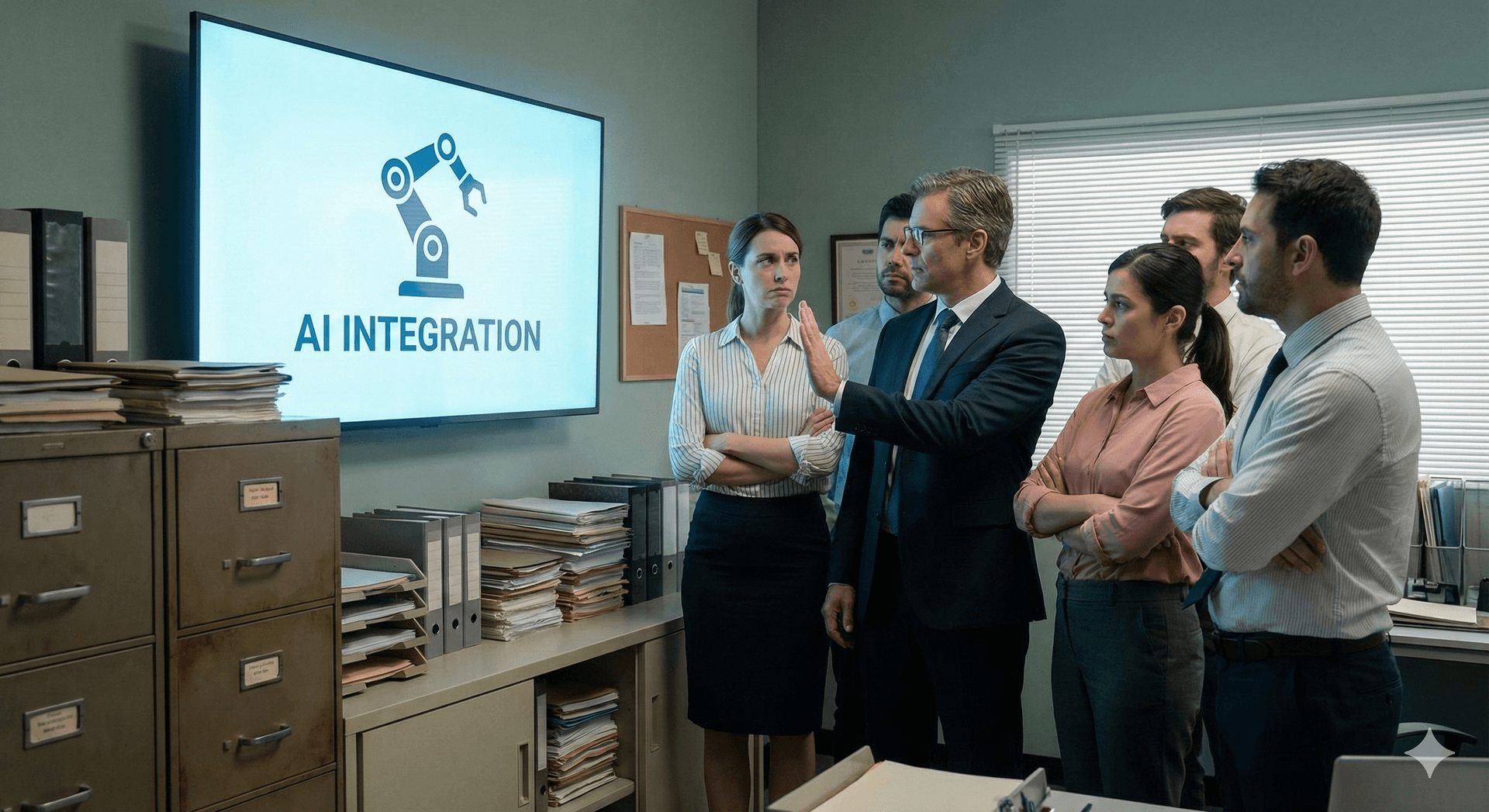
Business owners worry about data security and reliability. Employees worry that "AI is coming for our jobs." This cultural resistance can stop an implementation dead in its tracks.
The Truth: For SMEs, AI is rarely about replacing people. It’s about augmenting them—removing the drudgery so your valuable humans can focus on high-touch customer service and creative problem-solving.
4. Analysis Paralysis: "Where Do We Even Start?"
The AI landscape is chaotic. With thousands of new tools launching monthly, figuring out which one solves your specific problem feels overwhelming. It’s easier to do nothing than to risk choosing wrong.
Part 3: Crossing the Divide—How to Start Your AI Journey
Stop thinking about "Adopting AI" as a massive, expensive overhaul of your business. Think of it as hiring a very cheap, very fast intern to handle specific tasks.
Here is a practical, low-risk guide to getting started.
Step 1: Ignore the Tech, Define the Bottleneck
Don't start by looking at AI tools. Start by looking at your business. Ask your team one question:
"What is the one task you hate doing the most, that takes up the most time, and requires the least amount of actual brainpower?"
Is it scheduling meetings? Drafting repetitive sales emails? Summarizing meeting notes? That is your pilot project.
Step 2: Look for "Embedded AI" First
Before buying new software, look at what you already own. You likely already have powerful AI at your fingertips.
Microsoft 365 / Google Workspace: Both are aggressively integrating AI (Copilot and Gemini). Use them to summarize long email threads, draft document outlines, or analyze spreadsheet data instantly.
Your CRM (Salesforce, HubSpot, etc.): Most modern CRMs have built-in AI features for lead scoring or drafting outreach emails. Turn them on and test them.
Step 3: The Low-Hanging Fruit—Generative Text and Images
The easiest entry point right now is generative AI (like ChatGPT, Claude, or Midjourney).
Marketing: Use AI to brainstorm blog post titles, draft social media captions, or create basic graphical assets for newsletters.
Operations: Use AI to draft standard operating procedures (SOPs), internal memos, or rewrite awkward customer service emails to sound more professional.
Step 4: Involve Your Team Early (Reassurance is Key)
Don't spring AI on your employees from the top down. Frame it correctly:
"We are bringing in these tools so you can stop doing data entry and spend more time with clients."
Make your employees the "pilots" of the AI tools. When they see how much grunt work it removes from their plates, they become champions rather than resistors.
The Takeaway
For SMEs, AI is no longer a futuristic luxury; it is fast becoming a survival requirement. Your larger competitors are using it to move faster, and your customers are expecting the speed it provides.
Don't try to do everything at once. Find one painful, boring problem. Find one simple tool to fix it. Start small, start today, and watch your capacity grow.